





Summary
A comprehensive guide to configuring detailed timelines and automatic repetition using the Assignment Settings feature in the KnowledgeCity LMS.
Introduction
The Assignment Settings feature inside KnowledgeCity LMS provides granular control over when and how assigned Learning Paths must be completed. Admins can configure fixed schedules, dynamic deadlines relative to assignment date, and set up automatic recurrence for ongoing training requirements.
Steps to Follow
Accessing Assignment Settings
Assignment Settings can be accessed from multiple locations within the Knowledge City LMS where Learning Paths are assigned:
- From a User’s Profile > Assignments (or Learning Path) tab
- From a User Group’s > Assignments tab
- Directly from the Learning Paths & Assignments section of LMS
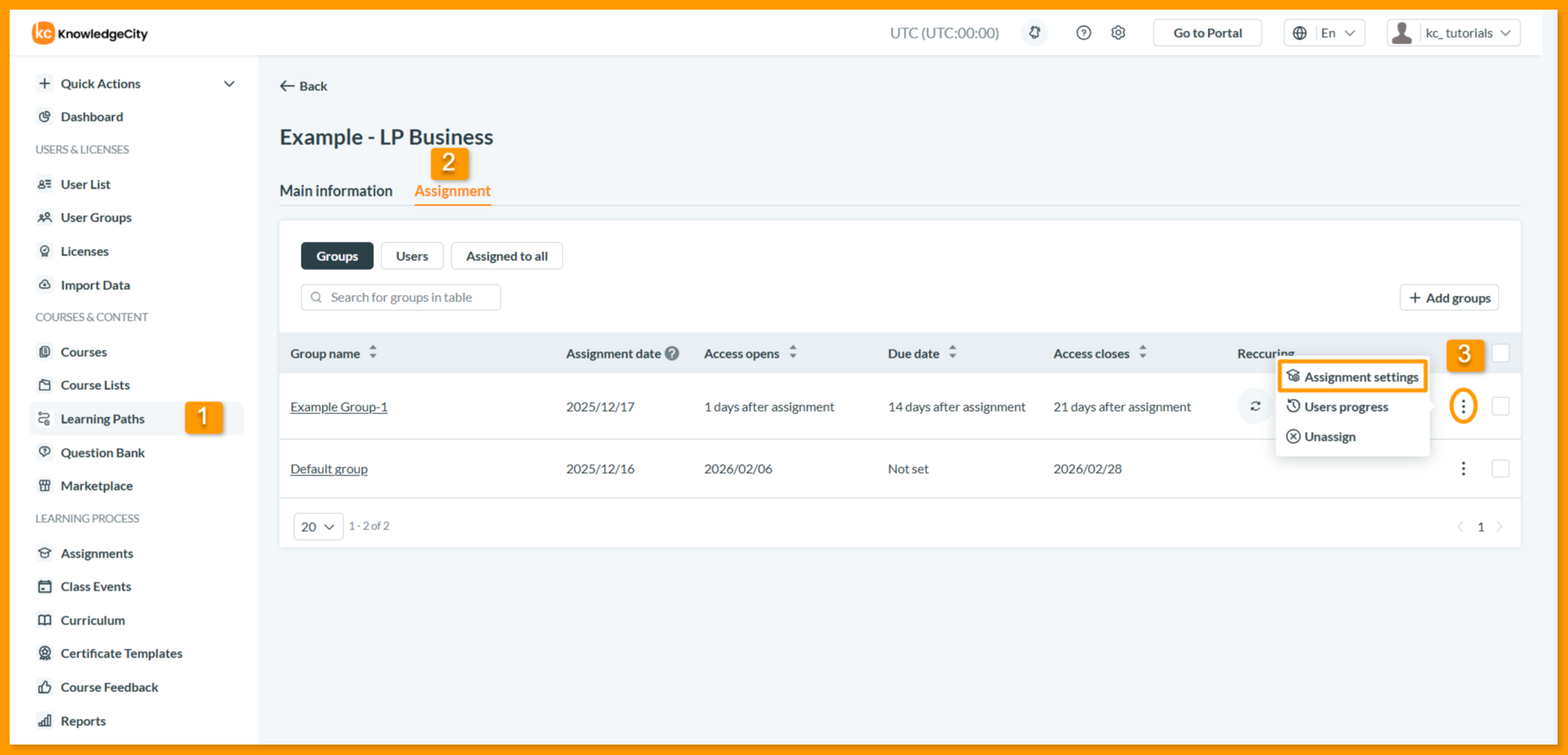
To open Assignment Settings:
- Locate the desired assignment
- Click the three-dotted actions menu (⋮) in its row
- Select "Assignment Settings" from the Actions menu
This opens a configuration window with two primary tabs: Learning Schedule and Recurring. When you open it for a single assignment, a third tab, Reminders, is shown alongside them.
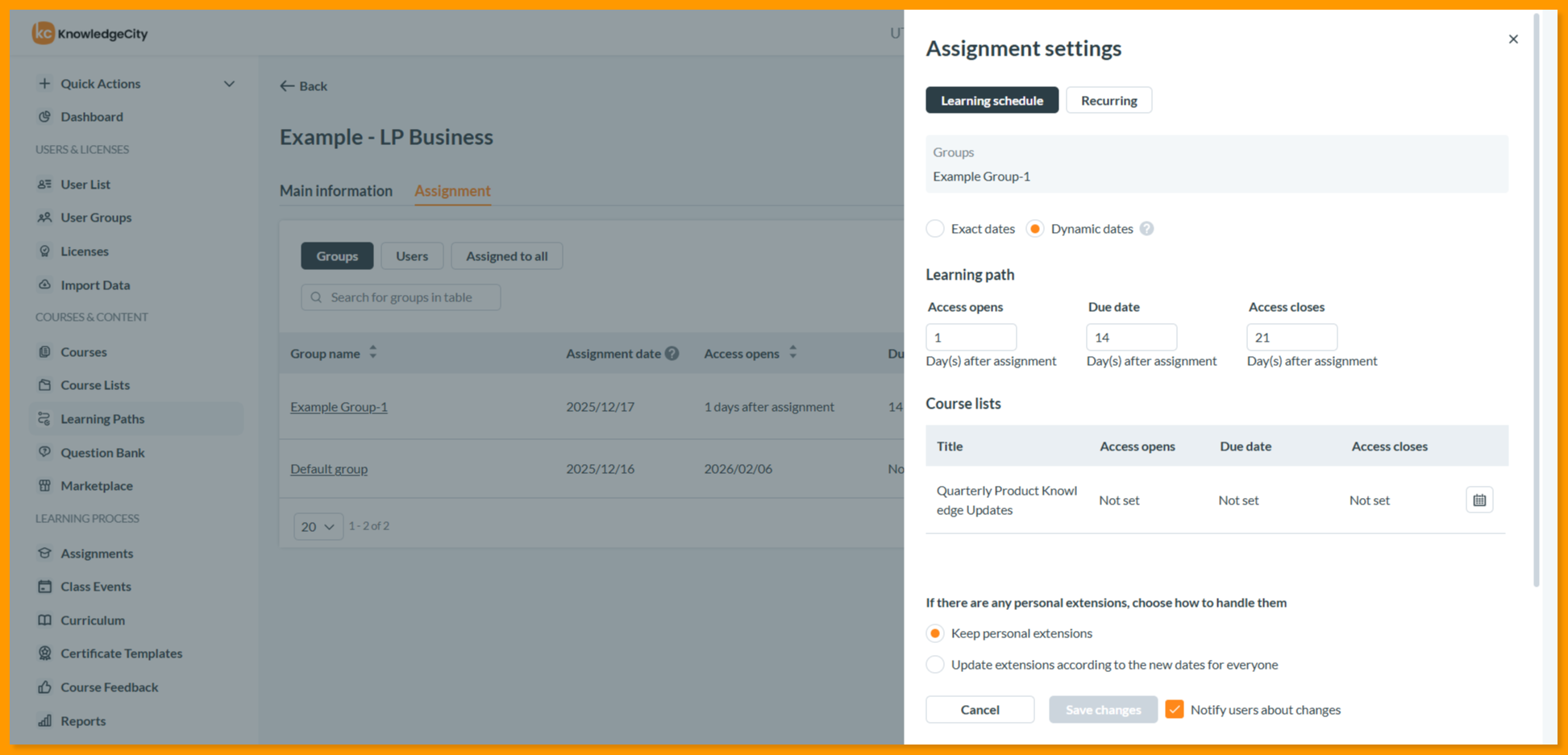
- The Learning Schedule tab controls when a user must complete the assignment (setting start dates, due dates, and access periods).
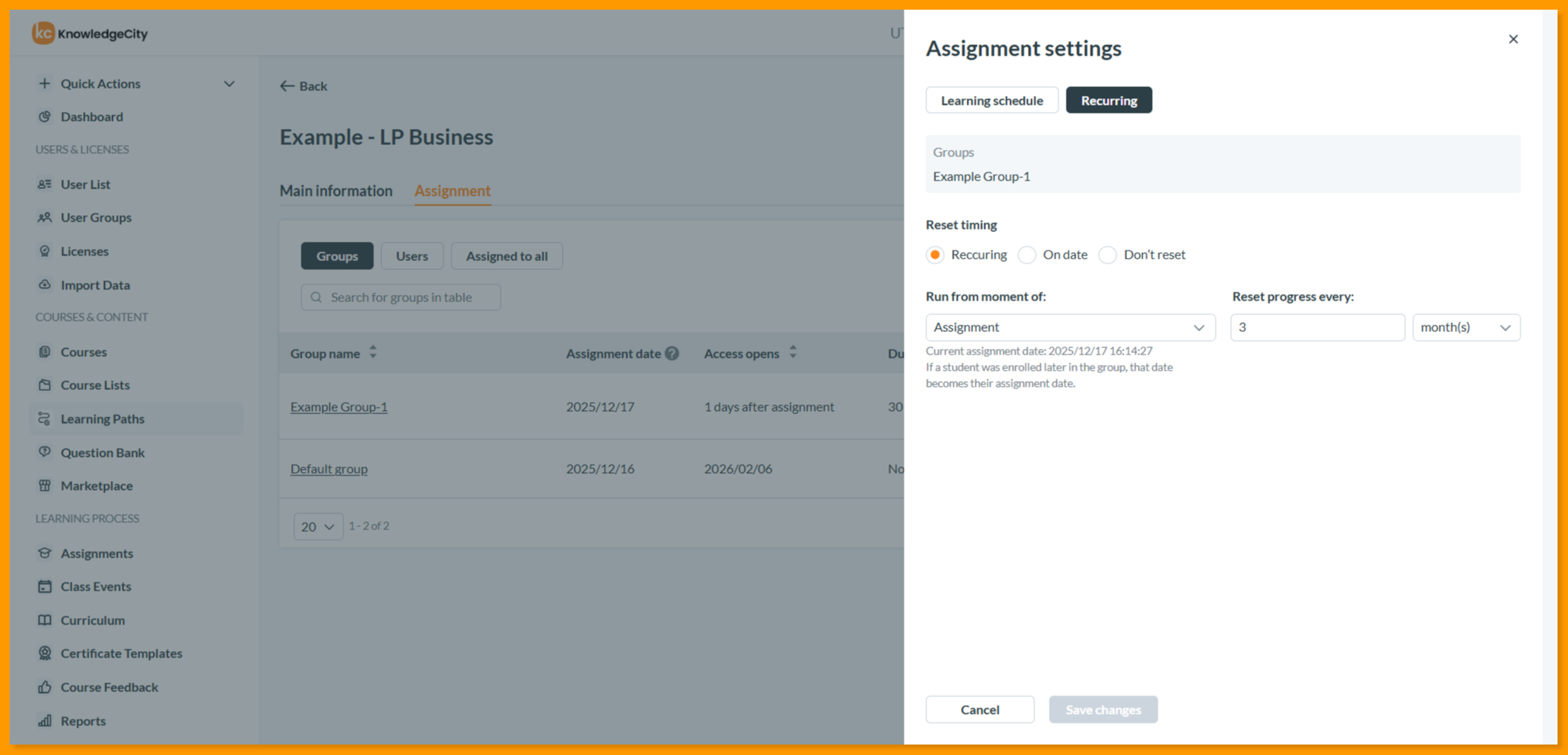
- The Recurring tab controls if and how often the assignment automatically resets and reassigns itself after completion (e.g., for annual compliance training).
- The Reminders tab controls whether follow-up emails are sent to learners who have not finished the assignment yet, and how often.
These settings allow you to define the initial timeline or the long-term repetition cycle of a learning assignment.
Tab 1: Learning Schedule
This tab controls when users can access and must complete the training. You can set schedules at two hierarchical levels:
- Learning Path (Global) Schedule: The default schedule that applies to all course lists within the path.
- Course List (Individual) Schedule: Specific settings that override the global schedule for that course list only. Set any field to "Not set" to inherit the global setting.
Example Scenario: A "Cybersecurity Annual Training" Learning Path has a global Due Date of December 31st. However, the "Phishing Awareness" course list within it can have its own Due Date of November 15th, while other course lists follow the December 31st deadline.
Schedule Type: Exact Dates vs. Dynamic Dates
For both levels, you have two methods to define deadlines:
Option A: Exact Dates
Set specific calendar dates for each deadline field. Ideal for training tied to fixed events or regulatory deadlines.
Option B: Dynamic Dates
Set deadlines relative to each user's assignment date. Use this for staggered enrollments to ensure consistent completion timelines regardless of start date.
| Setting | Exact Dates Behavior | Dynamic Dates Behavior |
|---|---|---|
| Access Opens | Specific calendar date when content becomes available | Day(s) after assignment when content becomes available (1 = access after one day) |
| Due Date | Specific calendar deadline for completion | Day(s) after assignment by which content must be completed |
| Access Closes | Specific calendar date when access is revoked | Day(s) after assignment when access expires |
Handling Personal Extensions
When modifying learning schedule where users already have personalized deadline extensions, you must choose how to handle these extensions:
- Keep personal extensions: Users with previously granted extensions retain their unique due dates. The new schedule applies only to users without extensions.
- Update extensions according to the new dates for everyone: All personal extensions are recalculated relative to the new schedule. For example, a user who had a 7-day extension from an old due date will receive a 7-day extension from the new due date.
Tab 2: Recurring Settings
Configure automatic reset and reassignment of training for compliance, annual refreshers, or ongoing skill development.
Option A: Recurring (Time-Based Cycle)
For training that repeats on a regular time interval (e.g., every 90 days, annually).
| Setting | Description |
|---|---|
| Run from moment of: | Determines when the reset timer starts:Passing learning path: Timer starts when user passes the entire pathEach course completion: Timer starts per course as completedAssignment: Timer starts immediately upon assignment |
| Reset progress every: | Frequency of reset cycle |
| Set up new availability dates (Optional): | If enabled, define the schedule for each new cycle using either Exact Dates or Dynamic Dates relative to the reset date |
Option B: On Date (Fixed Calendar Reset)
For training that must refresh on specific calendar dates (e.g., annual policy updates every January 1st).
| Setting | Description |
|---|---|
| Date: | Specific calendar date for automatic reset and reassignment |
| Set up new availability dates (Optional): | If enabled, configure the schedule for the new cycle |
Option C: Don't Reset (Default)
Standard one-time assignment with no automatic recurrence.
Tab 3: Reminders
The Reminders tab sends follow-up emails to learners who have not finished the assignment yet. It is shown when you open Assignment Settings for a single assignment, and not when you select several assignments and change them together.
- Send reminders until this assignment is completed: Toggle ON to start sending reminders, OFF to stop them.
- Remind after: With reminders on, list the intervals, in Days, at which each reminder is sent. Use Add reminder to add another interval, and the bin icon beside an interval (Remove reminder) to drop one.
What the intervals are counted from depends on how the Learning Path reached the user:
- Assigned through a user group: reminders are counted from the date each user joined the group, so every new joiner gets their own schedule.
- Assigned to a user directly: reminders are counted from the date the Learning Path was assigned to that user.
In both cases, users who have already completed the Learning Path are not emailed.
The tab accepts up to 12 reminders for one assignment. Each interval must be a whole number of days between 1 and 365, and no two intervals may be the same.
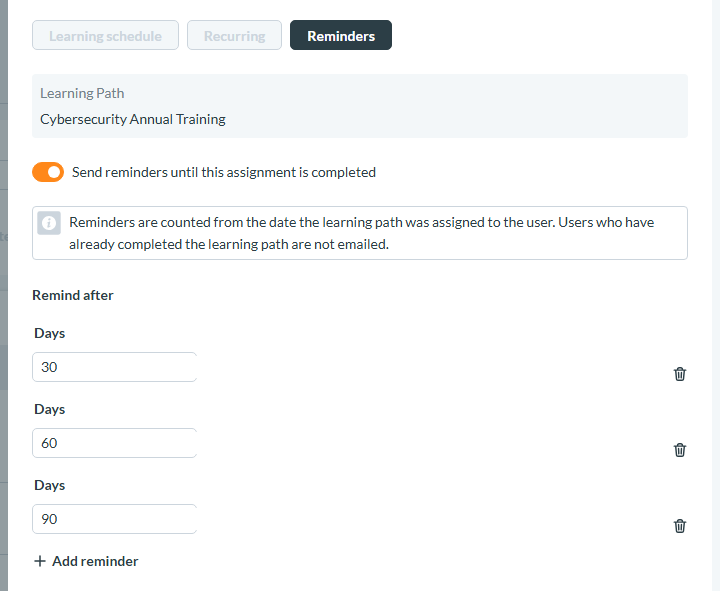
Caption: The Reminders tab sends follow-up emails to learners who have not finished the assignment yet.
Assignment Settings Configuration Examples
Example 1: Quarterly Product Knowledge Update
- Scenario: The sales team must refresh on updated product features every quarter, with a short completion window.
- Learning Schedule: Dynamic Dates. Access Opens: 1 day, Due Date: 14 days after assignment, Access Closes: 21 days after assignment.
- Recurring Settings: Recurring. Run from: Assignment, Reset every: 90 days.
- Outcome: The training is automatically reassigned every 90 days to all sales reps, giving them a consistent 2-week window to complete it from each cycle's start date.
Example 2: New Hire Onboarding Program
- Scenario: New employees, who start on various dates, must finish onboarding within their first month.
- Learning Schedule: Dynamic Dates. Access Opens: 1 day, Due Date: 30 days after assignment, Access Closes: 40 days after assignment.
- Recurring Settings: Don't Reset.
- Outcome: Regardless of hire date, each new hire gets the same 30-day deadline from their individual assignment date, with a 10-days grace period. No recurrence is needed.
Important Notes
- Multiple Access Points: Configure Assignment Settings from a User Profile, User Group, or the main Learning Paths & Assignments section.
- Group Settings Lock: Recurring and schedule settings applied at the Group level cannot be changed from an individual user’s profile.
- Extension Flexibility: While Group-level settings are locked, you can manually Extend User Learning Schedule from an individual's profile for personalized deadlines.
- Dynamic Dates Logic: For Dynamic Dates, deadlines are calculated from the user's original enrollment or assignment date into the group.
- Assignment Date: The original Assignment Date is permanent and does not change if you update the schedule or switch between Exact and Dynamic dates.
- User-Facing Dates: In emails and the learning portal, users always see calculated calendar dates, never dynamic expressions like "30 days after assignment."
- System Limits: For Recurring, "Days after assignment" fields have a maximum of 365 days (or 60 months).
- Personal Extensions: Your choice for handling existing personal extensions when updating a schedule applies immediately to all users.
- To-All Assignment Date: For a learning path assigned to all users, the Assignment date shows the date of the initial assignment.
- Per-Course Assignment Date: Course lists and courses inside a learning path each carry their own Assignment date.
- Recycle Bin: If an assignment is removed by mistake, it can be put back from the Recycle Bin page in the LMS left side panel for as long as the Days left column still shows time remaining. Restoring a learning path also restores its structure, assignments and translations.
- Restored Notifications: A restored notification comes back paused, so activate it again when you are ready to send.
Conclusion
The Assignment Settings feature empowers administrators to efficiently automate and personalize training schedules. By defining clear deadlines with Exact or Dynamic Dates, setting up automatic recurrence, and scheduling follow-up reminders, you can ensure timely compliance and continuous learning with minimal manual effort. This functionality is central to managing rolling enrollments, mandatory refreshers, and structured learning paths within the KnowledgeCity LMS, ultimately saving time while maintaining training rigor.