





Summary
Root Cause Analysis (RCA) in the Safety App lets you investigate why an incident happened rather than just recording what happened. It provides four structured analysis methods, 5 Whys, Fishbone, Fault Tree, and Bowtie, built directly into each investigation, and links every root cause you find to a corrective action.
Introduction
Root Cause Analysis is how the Safety App turns symptoms into systemic fixes. Instead of treating RCA as a separate tool or an after-the-fact write-up in a Word document, the discipline lives inside every investigation, with structured editors that capture each step of your reasoning. It is used by the safety team working an investigation, giving them a repeatable way to ask why an event occurred until the underlying, systemic cause surfaces.
The problem it solves is superficial incident handling. By requiring at least one completed RCA before an investigation can be submitted, and by linking each identified cause to a remediation, RCA ensures that investigations produce lasting fixes rather than quick patches.
Key Concepts
- 5 Whys is a sequential cause-and-effect chain where you repeatedly ask "Why?" until the systemic root cause surfaces. It supports up to seven levels of depth.
- Fishbone (Ishikawa) Diagram organizes potential causes into categories such as People, Process, Equipment, Environment, Materials, and Management, giving you a visual and collaborative view of contributing factors.
- Fault Tree Analysis is a top-down logic diagram: you start with the event at the top and trace every condition and combination of failures that could have produced it, making it rigorous and exhaustive.
- Bowtie Analysis is a risk visualization for high-consequence events, showing threats on the left, the event in the center, and consequences on the right, with preventive and mitigation barriers along each path.
- Corrective and Preventive Actions (CAPAs) can be created directly from any RCA method, so every identified root cause links to a remediation without copying and pasting between the investigation and the fix.
- Investigation gating means at least one completed RCA is required before an investigation can be submitted for approval, and the investigation cannot close until every identified root cause has a fix assigned.
Steps to Follow
Open the RCA tab within an investigation
RCA is not a standalone module. Open the investigation you are working, then go to the RCA tab on the investigation detail page. All four analysis methods are available there.
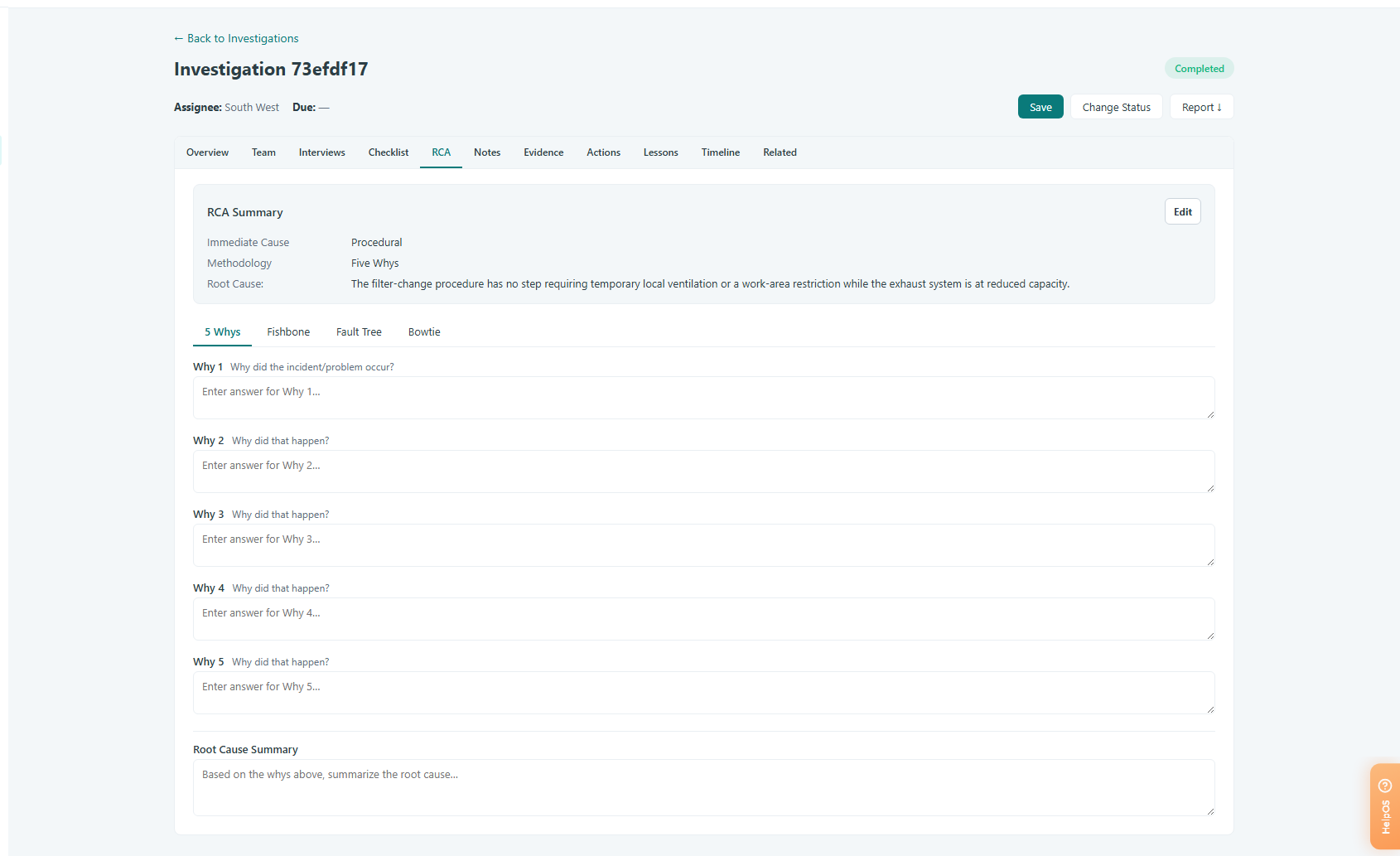
Caption: The RCA tab on the investigation detail page, with all four analysis methods.
Choose an analysis method
Pick the method that best fits the event. Use 5 Whys for a straightforward cause-and-effect chain, Fishbone to categorize many possible contributing factors, Fault Tree for a rigorous top-down breakdown of failure conditions, and Bowtie for high-consequence events where you want to map both preventive and mitigation barriers.
Work through the analysis in the structured editor
Each method has its own structured editor that captures your reasoning step by step. For 5 Whys, record each "Why?" and its answer, drilling down through up to seven levels until the systemic root cause is clear. For Fishbone, place each potential cause under the appropriate category (People, Process, Equipment, Environment, Materials, Management). For Fault Tree, start with the event at the top and trace every condition that could have led to it. For Bowtie, lay out threats, the central event, consequences, and the barriers along each path.
Link each root cause to a corrective action
From any RCA analysis, create a Corrective and Preventive Action (CAPA) for each root cause you identified. Each linked action carries an owner, a verifier who is different from the owner, a due date, and an effectiveness review scheduled at 30, 60, and 90 days.
Complete the RCA before submitting the investigation
You must complete at least one RCA before the investigation can be submitted for approval. Beyond that, the investigation cannot close until every identified root cause has a fix assigned, so confirm each cause has a linked action.
Conclusion
By keeping RCA inside every investigation and requiring each root cause to link to a corrective action, the Safety App helps your team move past symptoms and address the systemic conditions behind an incident. Choosing the right method, 5 Whys, Fishbone, Fault Tree, or Bowtie, and completing the analysis before submission ensures your investigations consistently produce durable, verifiable fixes.