





Summary
KC Library groups its courses under six top-level entries in the Learning library menu: Business Courses, Technology Courses, Safety Courses, Compliance Courses, Finance Courses, and Certification Programs. This article explains what each entry covers, who it serves, and what you take away from it, so you can decide where to look before you start browsing.
Introduction
The KC Library catalog holds more courses than you can scan in one sitting. Categories give the catalog a structure, so you can start from a subject you care about instead of reading every course title.
A category is a top-level subject grouping. The Learning library menu lists five subject categories and one program collection. A subcategory sits inside a category and narrows it to one branch of that subject. Categories are not all divided the same way, and a category can hold courses directly as well as inside its subcategories.
All Categories is a view, not a category. It opens the catalog with no subject filter applied, so you see the full range of content in one list. Use All Categories when you want to search or filter across every subject at once. Use a single category when you already know which subject area you need.
Key concepts
- Category: A top-level subject grouping in the Learning library menu that collects courses about one broad area.
- Subcategory: A narrower grouping inside a category that covers one specific branch of that category's subject.
- Category page: The page that opens when you select a category. It lists the courses in that category, and its subcategories where the category has them.
- Certification Program: A curated collection of the courses that prepare you for a recognized external certification, rather than a grouping by subject.
The categories
The five subject categories below cover the topics in the catalog. Each entry describes what the category holds, who tends to use it, and what you can do after working through its courses.
Business Courses
What it covers: Courses about how an organization plans its work, sells to customers, and manages its people.
Who it's for: You lead a team, or you work in sales, customer service, human resources, marketing, or operations. New managers use this category for the tasks that recur in a management role. Admins draw on it when they build a development program for a group.
What you'll find: Subcategories such as Sales, Customer Service, and Human Resources, along with the courses inside each. Further subcategories cover other business topics.
Skills you'll build:
- Run consultative sales conversations and write proposals that close sales.
- Handle difficult customer calls and resolve complaints using documented procedures.
- Coach team members and conduct structured performance reviews.
- Plan interviews, screen candidates, and onboard remote new hires.
- Lead teams through organizational change using change management models.
- Automate marketing content and customer outreach with AI tools.
Related: How to browse the KC Library catalogue, How to filter courses by category and subcategory, How to assign library content to learners
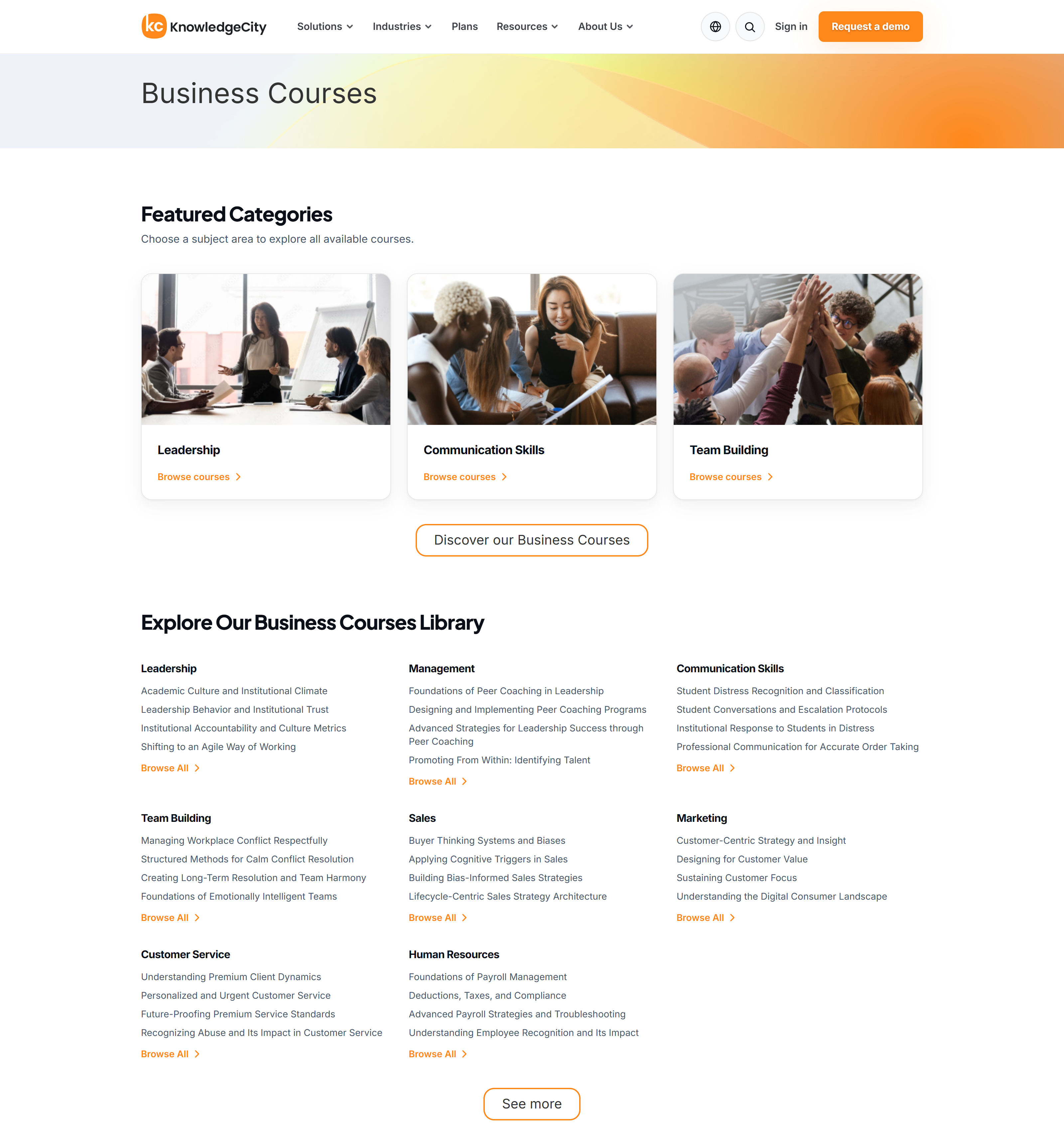
Caption: The Business Courses category on the public site, with its featured subcategories and the full subcategory library beneath them.
Technology Courses
What it covers: Courses about the software, systems, and technical practices people use to do their work.
Who it's for: You work in a technical role, or your work depends on tools you were never formally trained on. The same subject often appears at more than one skill level here, so check the level before you commit time to a course.
What you'll find: Subcategories such as Business Tools & Productivity, Software Development, and Graphic Design & Creative Tools, along with the courses inside each. Further subcategories cover other technical fields.
Skills you'll build:
- Create spreadsheets, databases, and diagrams using Microsoft Office tools.
- Write and debug programs using loops, functions, and data structures.
- Edit images, layouts, and video in Adobe creative applications.
- Prepare, summarize, and visualize datasets using Python data libraries.
- Train and evaluate machine learning models for clustering and prediction.
- Configure servers, networks, and firewall rules in cloud environments.
Related: How to filter courses by skill level, How to search the KC Library, Understanding the course detail page
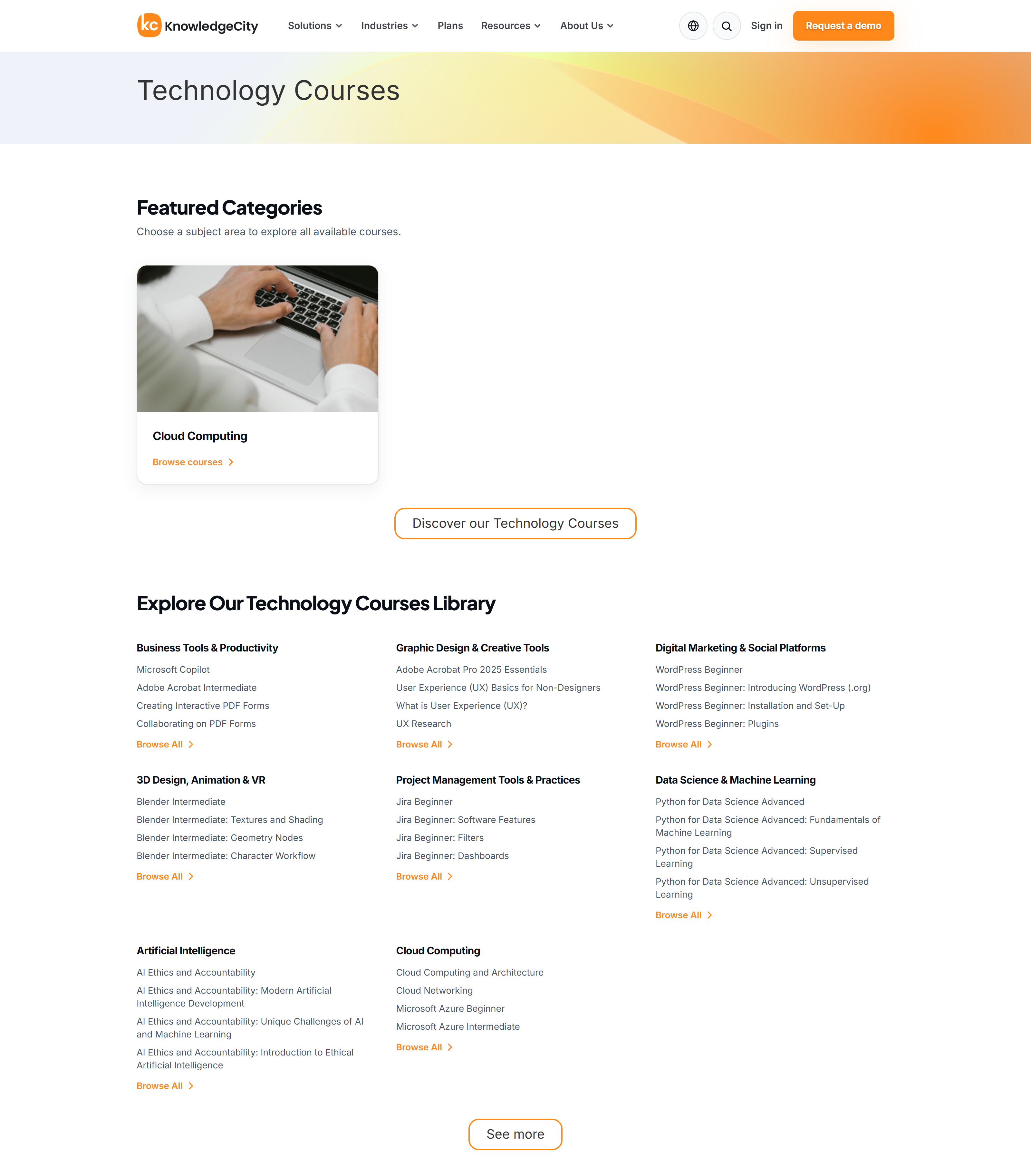
Caption: The Technology Courses category, whose subcategories run from Business Tools and Productivity through Software Development and Cybersecurity.
Safety Courses
What it covers: Courses about keeping people free from harm in the places where they work.
Who it's for: You work where physical risk is part of the job, such as a plant, a warehouse, a laboratory, or a construction site. Supervisors use this category to prepare a crew before a task, and admins use it to cover a site on a repeating schedule.
What you'll find: Subcategories such as Industrial Materials Safety, Workplace Physical Safety, and Industrial Equipment Safety, along with the courses inside each. Further subcategories cover other settings and risks.
Skills you'll build:
- Read GHS labels and safety data sheets to find hazard information.
- Identify workplace hazards and correct unsafe conditions before accidents happen.
- Match fire extinguishers to fire classes and use them safely.
- Develop and practice emergency action plans covering evacuation procedures.
- Use safe lifting and posture techniques to prevent back injuries.
- Inspect heavy equipment and guide operators safely as a spotter.
Related: How to add library courses to a learning path, How to launch and watch a course from the library, How to get your course completion certificate
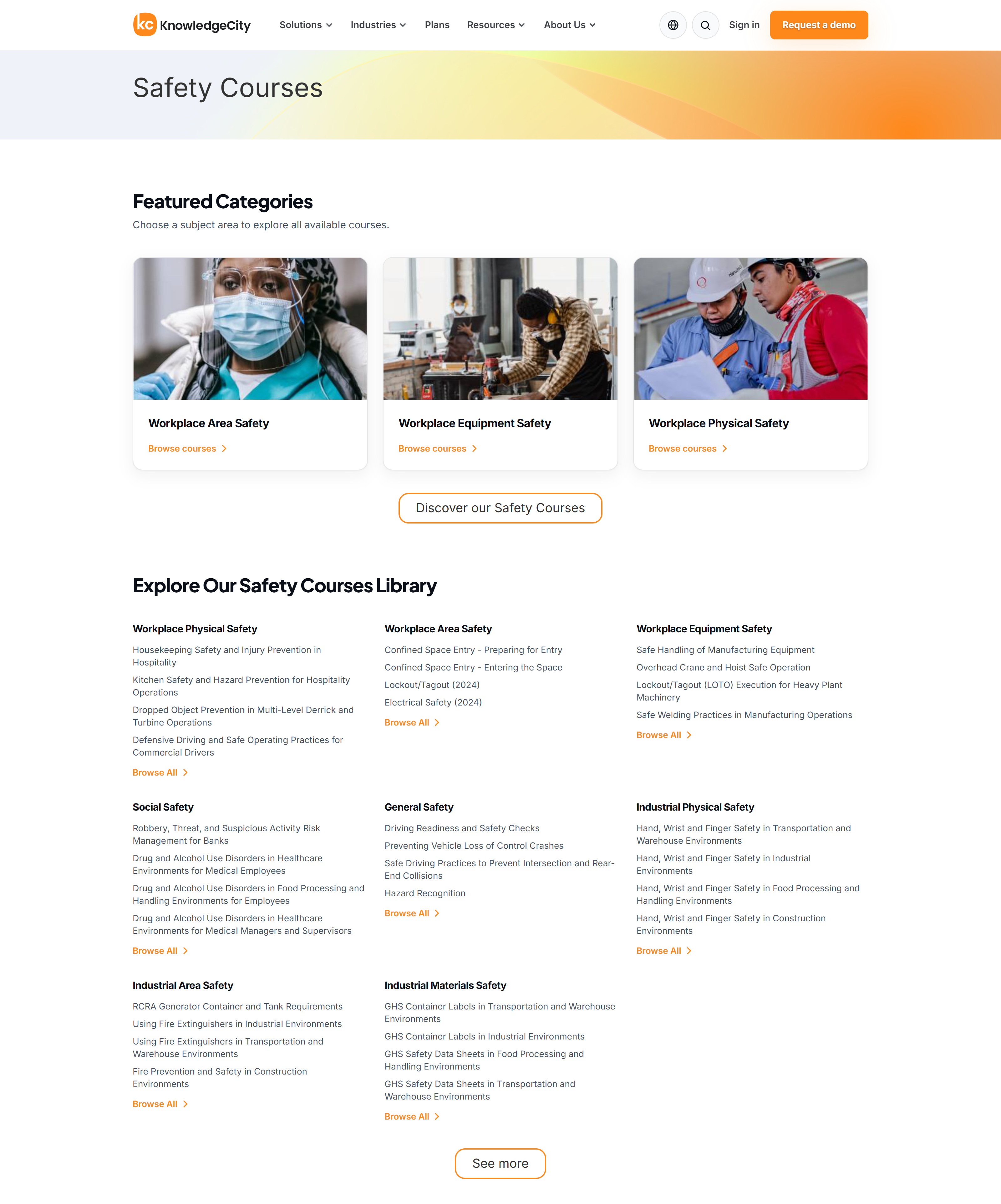
Caption: The Safety Courses category, grouped by setting and risk: workplace area, equipment, physical and industrial materials safety.
Compliance Courses
What it covers: Courses about the rules an organization has to follow, and the conduct those rules require.
Who it's for: You have an obligation to meet that comes from law, regulation, or company policy. This training is usually assigned to you rather than chosen. Compliance, legal, and human resources leads use the category to cover a defined group and keep a record of completion.
What you'll find: Subcategories such as Global Compliance Essentials, Legal and Ethics Training, and Environmental Health, along with the courses inside each. Further subcategories cover other obligations.
Skills you'll build:
- Recognize and report workplace harassment under state and federal law.
- Respond to data subject requests under GDPR and CCPA.
- Investigate EEO complaints and process ADA accommodation requests.
- Apply anti-bribery laws and identify conflicts of interest.
- Document environmental risks and meet EPA reporting duties for facilities.
Related: How to assign library content to learners, How to get your course completion certificate, How to filter courses by language
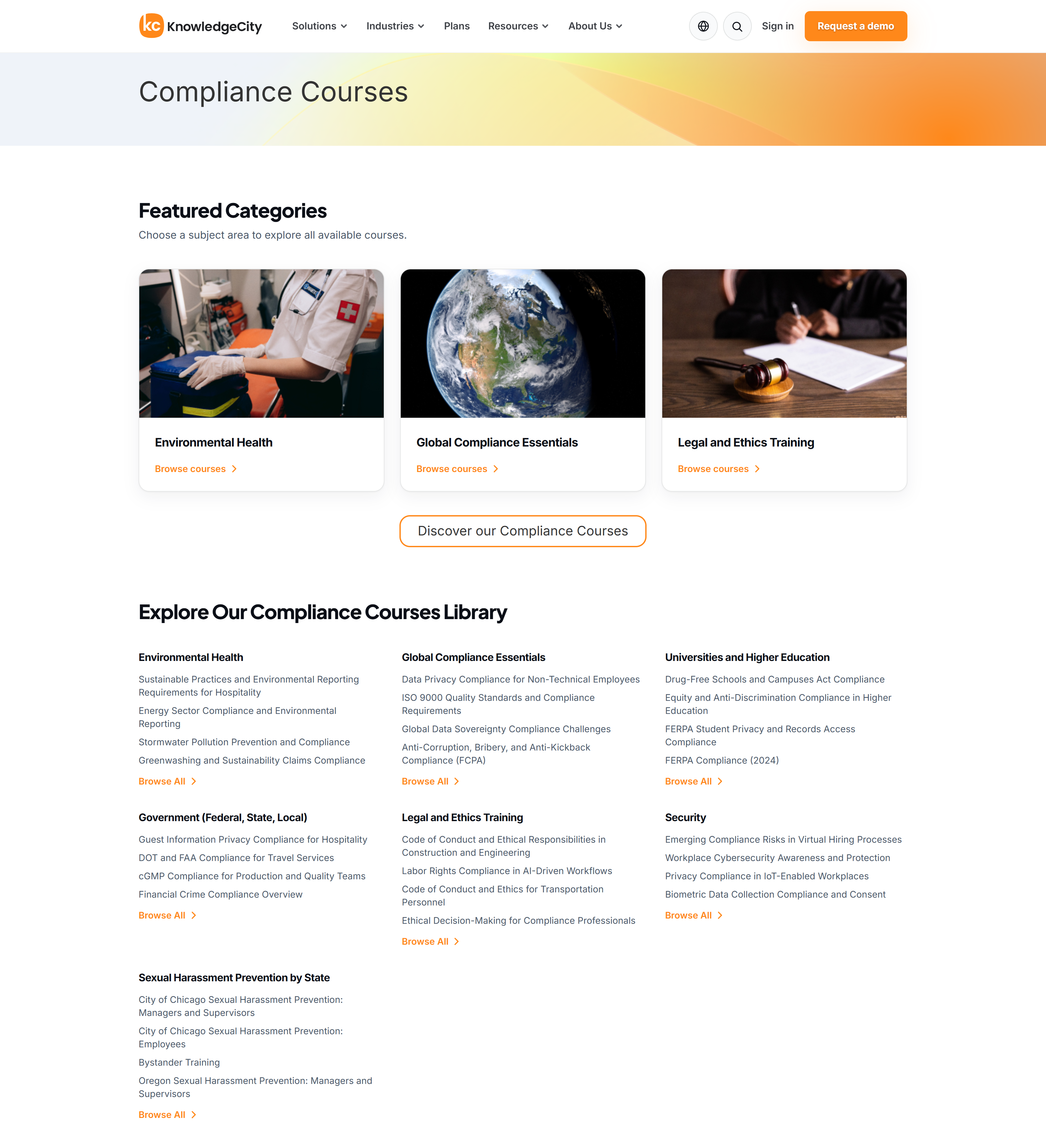
Caption: The Compliance Courses category, covering Global Compliance Essentials, Legal and Ethics Training, and Environmental Health.
Finance Courses
What it covers: Courses about money in an organization: how it is recorded, reported, controlled, and planned.
Who it's for: You work in accounting, finance, audit, or banking operations, or you own a budget without a finance background. Finance teams also use this category to bring new hires to a shared standard on reporting and controls.
What you'll find: Subcategories such as Finance and Investing, Accounting Principles, and Retail Banking, along with the courses inside each. Further subcategories cover other finance topics.
Skills you'll build:
- Build financial forecasts from balance sheets and cash flow statements.
- Detect fraud in bank transactions using behavioral warning signs.
- File suspicious activity reports that meet anti-money laundering rules.
- Diversify an investment portfolio to match stated financial goals.
- Design internal accounting controls that prevent financial statement errors.
- Hedge currency risk using forwards, futures, swaps, and options.
Related: How to filter courses by duration, How to sort catalogue results, Understanding the course detail page
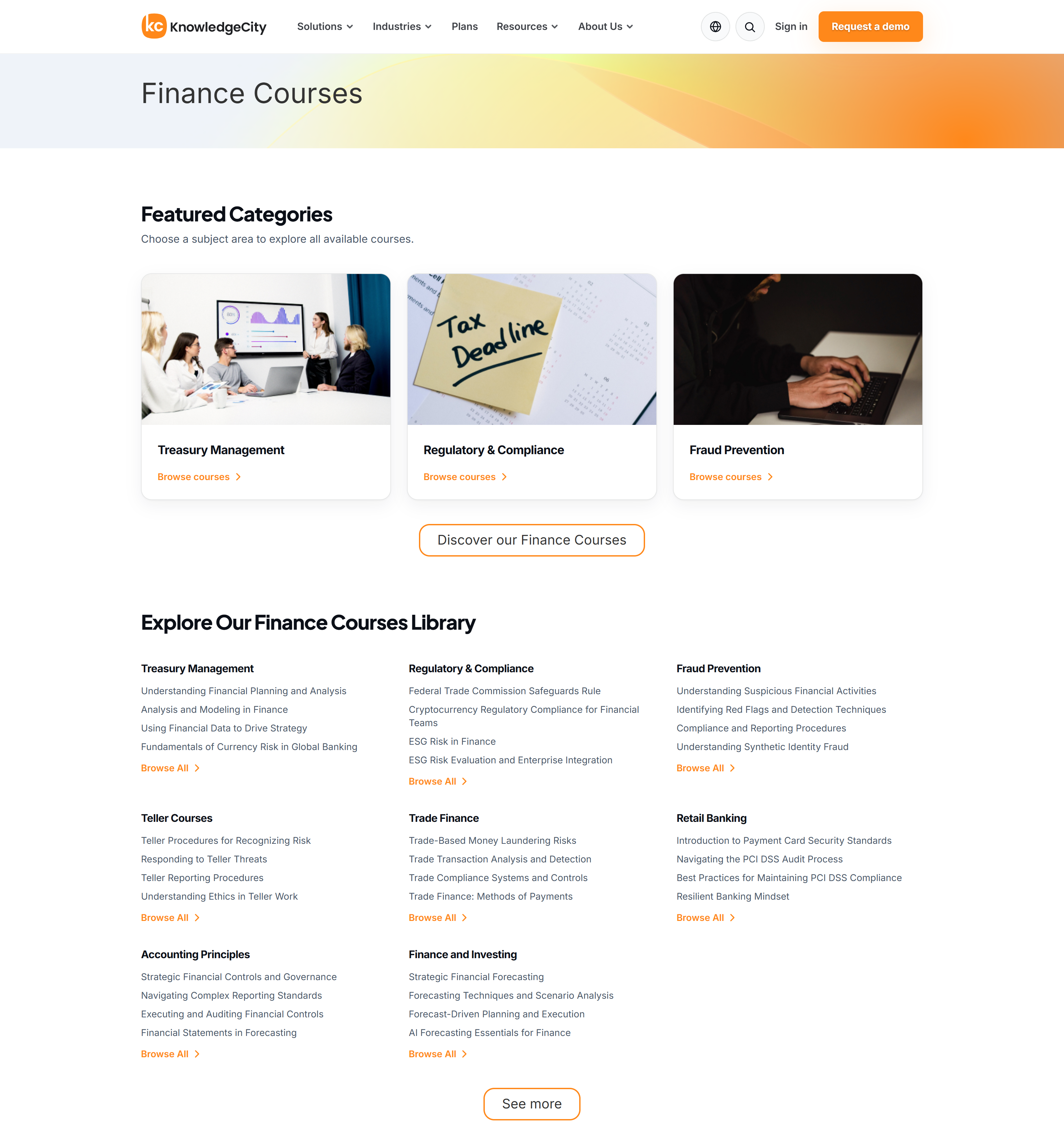
Caption: The Finance Courses category, from Accounting Principles and Treasury Management through Finance and Investing and Retail Banking.
Certification Programs
Certification Programs sits in the same menu as the five subject categories, but it works differently. A subject category answers the question "what do I want to learn about?" A certification program answers the question "what does this credential require of me?" The courses inside a program are pulled together because an external certification body recognizes them, not because they share a topic. A program can therefore include courses that also appear in other subject categories. Programs are grouped by certification body, and each one shows a name, a provider ID, a logo, a description, and a course count.
What it covers: Curated collections of the courses that KnowledgeCity has associated with a recognized external certification body.
Who it's for: You hold a professional credential that requires continuing education, or you are working toward one. Use this section when your goal is a credential rather than a subject.
What you'll find: One collection per partner certification body, including PMI, SHRM, HRCI, and IIBA, with the associated courses and a Courses count inside each.
Skills you'll build:
- Assemble the accredited courses tied to one certification body's credential.
- Track continuing education credits toward PMI, SHRM, HRCI, or IIBA recertification.
- Evidence coursework taken from an authorized or endorsed education provider.
- Compare a program's course count against your credential's credit requirement.
- Confirm which certification body governs the credits you are earning.
Related: Understanding accreditations and CEU credits, How to get your course completion certificate, Browsing the public learning library on knowledgecity.com
Choosing the right category
Some subjects sit close to two categories. Two pairs cause most of the uncertainty.
Compliance Courses or Safety Courses: Ask what the training protects. Safety Courses protects a person from physical harm during a task, so it teaches you to read a chemical label before you handle the container. Compliance Courses protects the organization from breaking a rule, so it covers the reporting duty that the same chemical creates for the facility. If the training was assigned to you because a law or a policy requires it, start in Compliance Courses. If you need it before performing a task, start in Safety Courses.
Finance Courses or Business Courses: Ask whether the subject is the money itself. Finance Courses covers recording, reporting, and controlling money. Business Courses covers running the organization, including decisions that spend money, without the accounting behind them. A budget owner planning a year often needs both.
When either choice looks reasonable, use All Categories and search the whole catalog.
Conclusion
The five subject categories give you a starting point by topic, and Certification Programs gives you one by credential. All Categories stays available when the subject boundary is unclear or when you would rather search the full catalog. Once you know where to look, the browsing article walks through the steps.