





Summary
The Executive Safety Scorecard condenses your organization's safety program into a single-page view. It brings together your recordable injury rate (TRIR), open action items, the leading incident types and locations, and training compliance so leaders can read the state of safety at a glance. It is built for a fast, high-level review rather than deep case-by-case investigation.
Introduction
The Executive Safety Scorecard is a summary report in the Safety App that rolls up the data captured across incident reporting and safety operations into one concise page. Instead of paging through the incidents queue or individual reports, you see the handful of numbers and rankings that describe overall program health, presented together so they can be compared and trended in a single glance.
It is designed for executives, safety managers, and other leaders who need to understand how the program is performing across sites without working through raw incident detail. The scorecard solves the problem of scattered data: it pulls TRIR, outstanding work, incident patterns, and training status into one place, giving decision-makers a shared, defensible picture of where the program stands and where attention is needed.
Key Concepts
- TRIR (Total Recordable Incident Rate): The headline safety metric on the scorecard, summarizing how frequently recordable incidents occur so leadership can gauge overall injury performance at a glance.
- Open items: The count of outstanding safety actions and follow-ups that have not yet been closed, giving a quick read on how much work is still in progress.
- Top incident types: A ranking of the most common incident categories (such as injury or illness, near miss, property damage, equipment failure, safety observation, and environmental incident) so recurring problem areas stand out.
- Top incident locations: A ranking of the sites or locations where the most incidents are occurring, helping direct attention to where risk is concentrated.
- Training compliance: A measure of how well the workforce is keeping up with required safety training, shown alongside the incident data so gaps are visible next to outcomes.
- Single-page scorecard: The whole report is intentionally kept to one page, so all of the above appears together for a fast executive review rather than a deep-dive investigation.
Steps to Follow
Open the Executive Safety Scorecard
From within the Safety App, navigate to the reporting area and open the Executive Safety Scorecard. The scorecard loads as a single page that summarizes your current safety program data, so no report has to be assembled by hand.
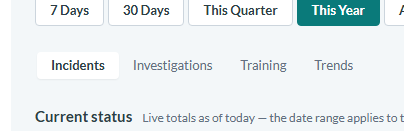
Caption: The scorecard lives on the Executive Dashboard's Incidents view, one of the four views reached with the segmented toggle.
Read the TRIR headline
Start with the TRIR figure. This is the scorecard's top-level indicator of recordable incident frequency and is meant to be the first number you check when assessing overall performance.

Caption: TRIR leads the scorecard, alongside LTIR, DART Rate, Open Incidents, Avg Days to Close, and Overdue Actions.
Review open items
Check the open items total to see how many safety actions and follow-ups remain outstanding. A rising or high count signals unresolved work that may need to be prioritized or reassigned.
Scan the top incident types and locations
Look at the top incident types to identify which categories of incident are most common, and the top incident locations to see which sites are generating the most reports. Reading these two rankings together helps you spot where a specific kind of problem is concentrated in a specific place.
Check training compliance
Review the training compliance figure to confirm the workforce is staying current with required safety training. Because this appears on the same page as the incident data, you can weigh training gaps directly against safety outcomes.
Use the scorecard for review and follow-up
Treat the scorecard as your starting point for leadership reviews. When a number stands out, use it to decide where to dig deeper in the underlying Safety App records, such as the incidents queue or individual reports, rather than trying to investigate from the scorecard itself.
Conclusion
The Executive Safety Scorecard turns a scattered safety program into a single, readable page, pairing the TRIR headline with open items, leading incident types and locations, and training compliance. By giving leaders one consistent view, it makes it easy to see how safety is trending and where to focus next.