





Summary
The lessons learned library in Safety App turns closed investigations into searchable institutional memory. When an investigation closes, a safety manager promotes its key findings into a lessons learned entry, and every entry, tag, and linked investigation lives in one central, filterable list your whole organization can draw on.
Introduction
A safety program that does not learn from its own incidents tends to repeat them. The lessons learned library is the antidote: it captures what an investigation uncovered, the root cause behind it, and the corrective action that actually worked, then keeps that knowledge where future teams can find it.
Safety managers use the library to record lessons as investigations close, and the wider organization uses it to search prior cases before facing a similar risk again. Because every lesson links back to the investigation that produced it, program memory and the original case are always one click apart.
Key Concepts
- Lessons learned entry: A record promoted from a closed investigation that captures its title, summary, root cause, and the corrective action that worked.
- Institutional memory: The searchable body of knowledge the library builds up as each closed investigation contributes a lesson, so prior experience is available to everyone.
- Tags: Labels applied to each lesson by category, hazard, location, and equipment, so that a future search lands on the exact prior case that matters.
- Linked investigation: The original investigation that produced the lesson. Every entry links back to its source case for one-click access to the full detail.
- Audience and publication status: Settings shown at the top of a lesson that control its scope. A lesson can be published organization-wide, scoped to a single site, or kept internal to the safety team.
- Filters: Controls for narrowing the library by category, hazard, location, or date, and these can be combined to surface every prior case that matches today's risk.
- Central library: The single searchable list that holds every entry, every tag, and every linked investigation in one place.
Steps to Follow
Promote findings from a closed investigation
When an investigation closes, promote its key findings into a new lessons learned entry. This is how a resolved case becomes reusable program memory rather than a one-off record.
Fill in the core lesson fields
Record the title, summary, root cause, and the corrective action that worked. These fields describe what happened, why it happened, and the fix that resolved it, so a future reader gets the full picture at a glance.
Tag the lesson
Apply tags by category, hazard, location, and equipment. Thorough tagging is what makes future searches land on the right prior case, so take the time to classify the lesson accurately.
Set the audience and publication status
Choose how far the lesson should reach. You can publish it organization-wide, scope it to a single site, or keep it internal to the safety team. The audience and publication status appear at the top of the lesson.
Browse and filter the central library
Open the lessons learned library to see every entry in one searchable list. Use the filters to narrow by category, hazard, location, or date, and combine them to surface every prior case that matches the risk you are looking into today.
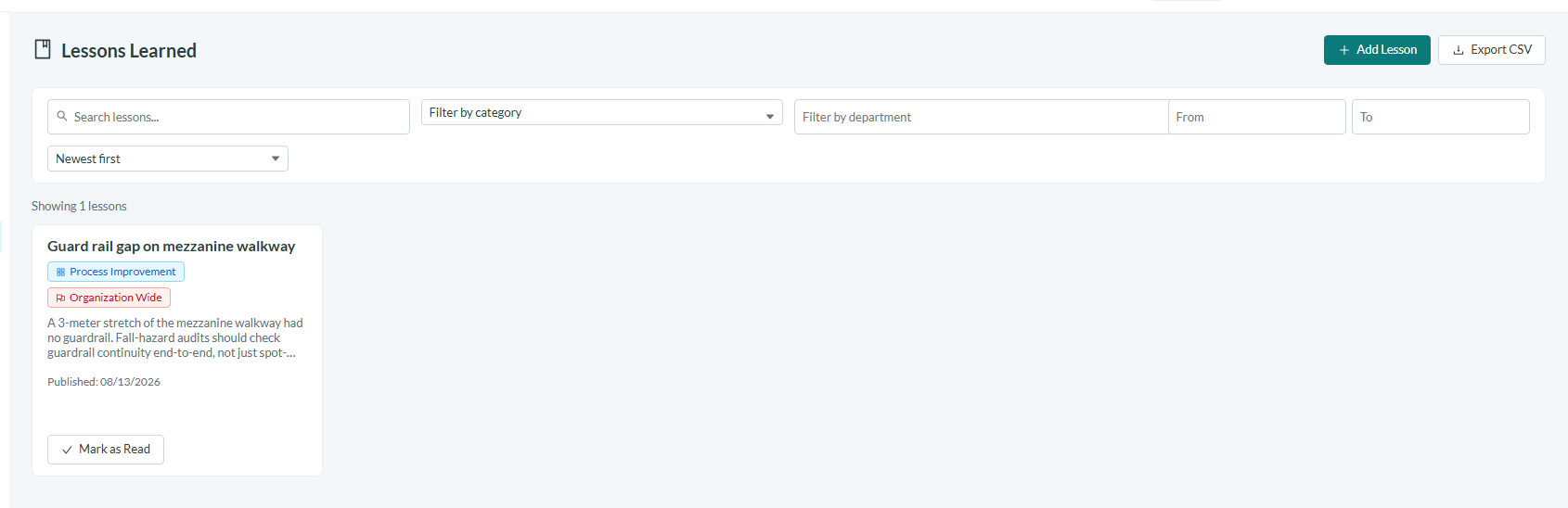
Caption: Open the lessons learned library to see every entry in one searchable list.
Open a lesson to see the full record
Select a lesson to reveal its full record, including the title, summary, root cause, the corrective action, and the original investigation that produced it. The tags, audience, and publication status surface at the top of the record.
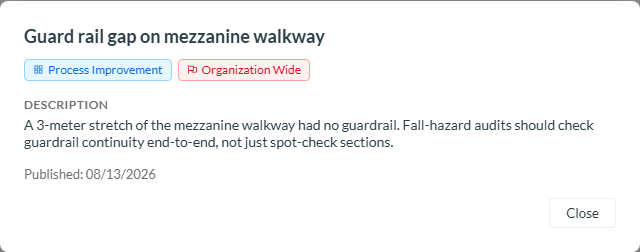
Caption: Select a lesson to reveal its full record, including the title, summary, root cause, the corrective action, and the original investigation that produced it.
Jump back to the source investigation
From any lesson, follow the link to its linked investigation. One click takes you from program memory to the original case, so you can review the complete investigation behind the lesson.
Conclusion
By promoting the findings of each closed investigation into a well-tagged lesson, your team builds a searchable memory that keeps hard-won safety knowledge available to everyone. The library's filters and links back to source investigations mean the right prior case is always close at hand the next time a similar risk appears.